Frozen shoulder is invisible — so colleagues, husbands, even doctors don't see how much it hurts. Here's what women over 45 are quietly doing at 2am, when the pain is worst and nobody else is awake.
See How It Works →You know how this conversation goes.
You describe the pain. You describe the nights. You describe how you can't do up your bra or wash your hair or close the boot of the car.
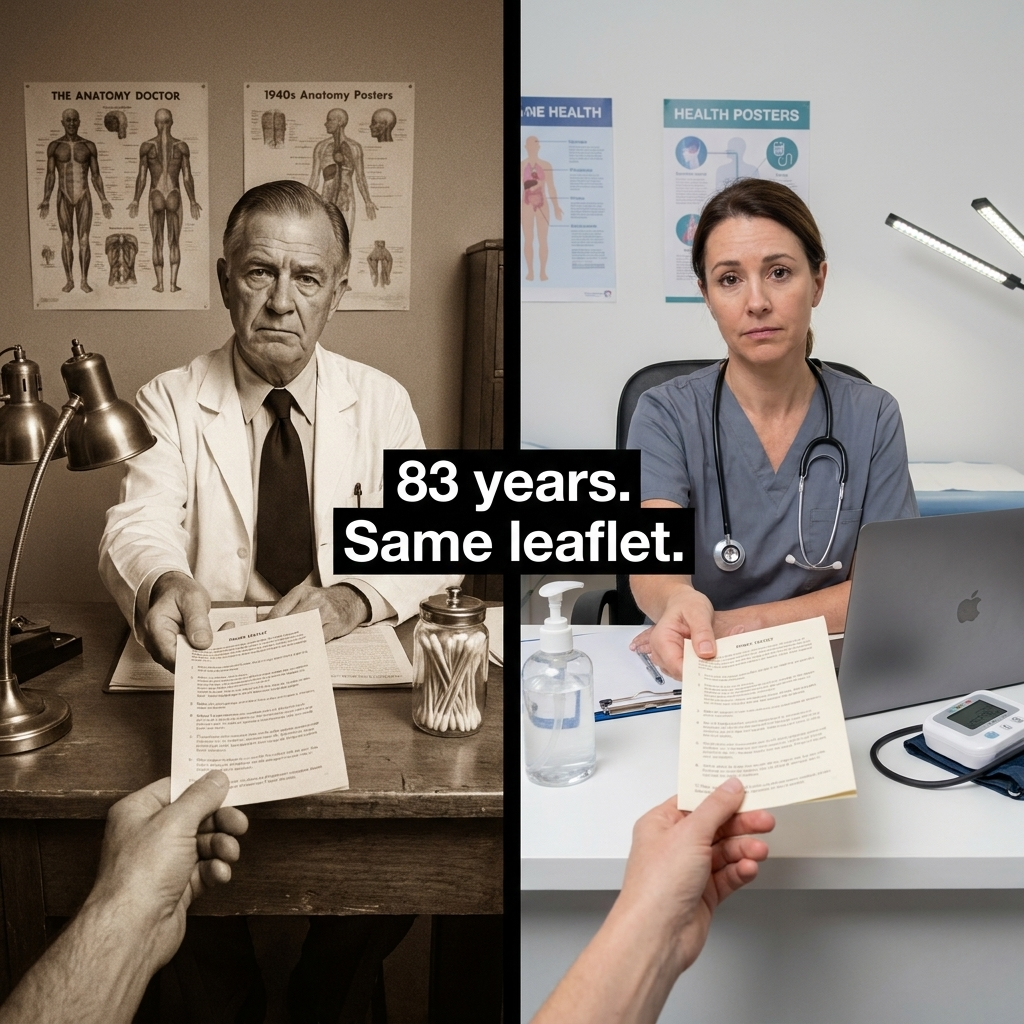
And your doctor says the same thing every other woman in this position has been told. "There's nothing I can do for you. It should go away on its own. It can take one to three years. Try to manage the pain."
Then you get a printed leaflet.
That advice — the "just wait it out" advice — isn't new. It comes from the 1940s. For eighty years, the standard medical position has been that frozen shoulder is a "self-limiting" condition that runs through tidy stages and ends in full recovery.
In 2017, a systematic review published in the journal Physiotherapy looked at that assumption and found it isn't supported. In one of the case series the review examined, 35% of patients still had symptoms about 4.4 years later. The authors wrote that "clinical evidence of persistent limitations lasting for years contradicts this assumption."
Nobody is saying your doctor is a bad doctor. They're giving you the advice they were trained to give.
But you aren't imagining it when you tell your husband that waiting isn't working.
The battle doesn't happen in your doctor's office. It happens at 2am, in your bed.
ShoulderEase is a cordless heated wrap, designed for women 45 and older with frozen shoulder, at the one moment they need help most — bedtime.
Here's the whole thing.
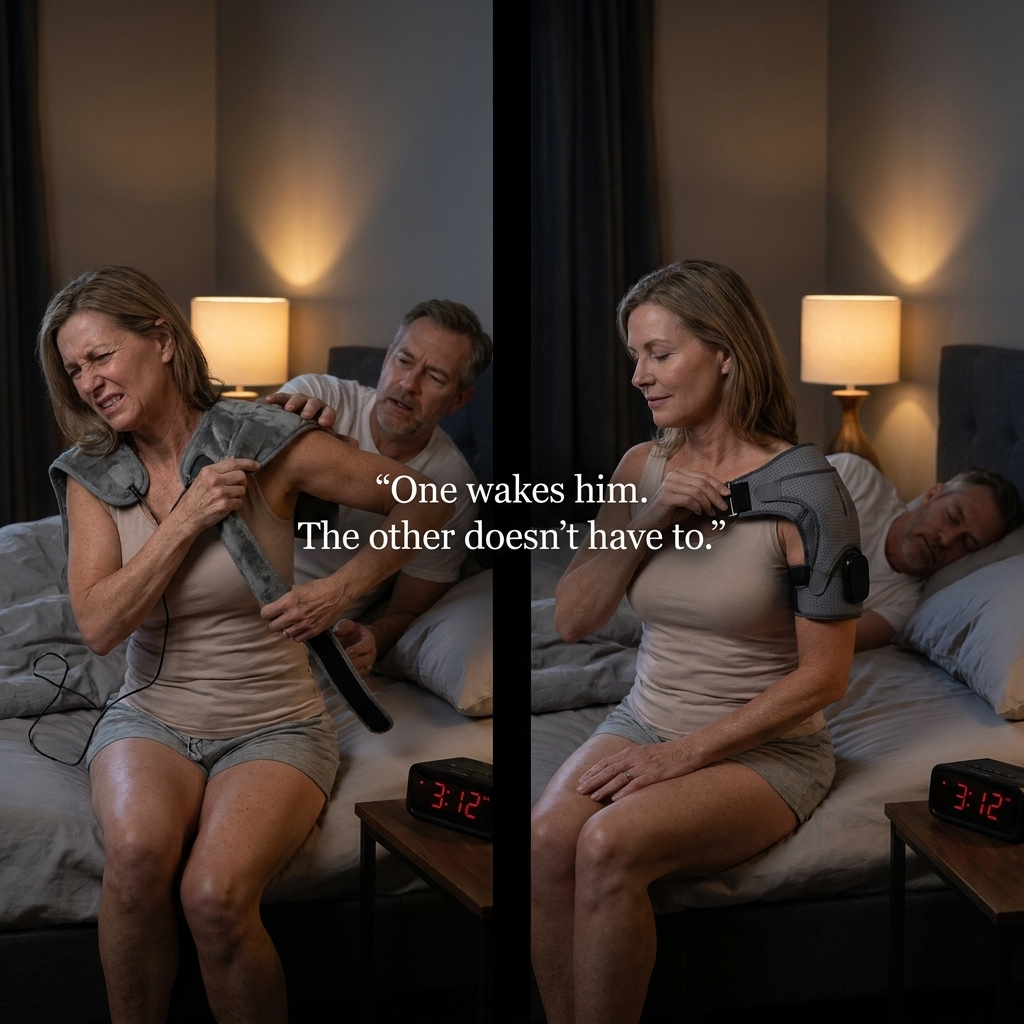
Wrap. You put it over your shoulder. One side at a time. No cords. No batteries to swap out. No settings to figure out.
Warm. Heat spreads across the front, the top and the back of the joint — not the two tiny spots you get on a cheap Amazon wrap. There's a gentle vibration underneath. One woman on a frozen shoulder forum described what helps her this way: "the slow rhythmic motion of forward and backward without pain seems to gently warm up the shoulder joint and it gives relief." That's what ShoulderEase was built to do.
Sleep. Fifteen minutes, in bed, on your side or your back. The wrap shuts off automatically. You don't have to remember.
No pills. No needles. No corded heating pad that pins you to the sofa. No one else in the room.
You don't break ice with force. You thaw it.
ShoulderEase isn't a cure for frozen shoulder, and we're never going to call it one. It's designed for comfort and better sleep — the one window your pills and your physio don't reach.
Here's the test every other heated shoulder wrap on the market fails.
Go on Walmart right now and read the one- and two-star reviews of the top-selling wraps. You will see the same sentence over and over.
"Cannot put on without assistance."
Think about who's buying these things. Women who can't reach behind their back. Women who can't raise their arm above shoulder height without the "electric shock" shooting down the arm. Women whose shoulder, by bedtime, is stiffer than it's been all day.
And the wrap they ordered expects them to fasten it between their shoulder blades.
That is the design flaw that sinks every cheap wrap on Amazon. Not the heat. Not the vibration. Not the battery. The fastening.
ShoulderEase was built for one arm. Your good one.
The arm loop slides on first, using the hand that still works. The front panel flips across your chest and clicks into a magnetic fastener right below your collarbone. You can see it the whole time. You never reach behind your back. You never ask anyone to help.
If you can put on a dressing gown, you can put this on.
That matters at 10pm. It matters more at 2am, when you've been lying there for three hours and your shoulder has locked up and the person next to you has finally gotten to sleep and you don't want to wake them for the fourth time this week.
You have probably noticed this pattern without being able to explain it.
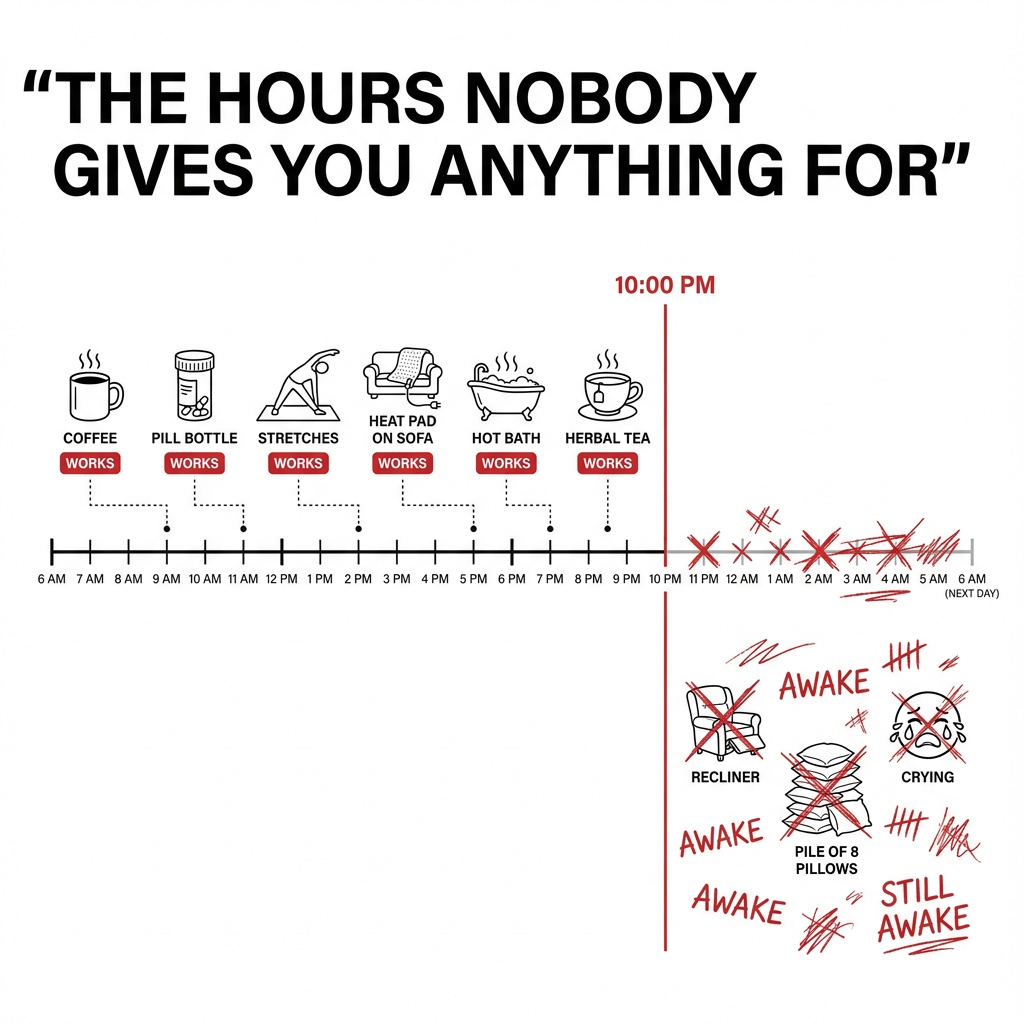
The painkillers your GP prescribed take the edge off at breakfast. The stretches your physio gave you feel okay in the morning. The heat pad on the sofa helps while you're sitting with your cup of tea at 3pm.
Then you get into bed. And by midnight, nothing is working.
This isn't new.
In 1934, an American surgeon named Ernest Codman gave frozen shoulder its name. One of his original diagnostic criteria was "inability to sleep on affected side."
Ninety years ago, before most of the treatments you've been offered even existed, the defining symptom of this condition was already the night.
The hours in bed are long. The joint stiffens. The muscles around it tense. By 2am you are awake, in pain, and your weekly physio appointment is five days away. The pill you took at 10pm is wearing off and you don't want to take another one.
One woman on a frozen shoulder forum posted at exactly that hour. She wrote: "The time is now 2am in the UK i have beennasleep for 2 and a half hours and am awake with pain."
Another woman wrote: "Sleep is like gold dust, you lose your motivation, you lose 'you', the independence to wash, dress, even prepare and eat your own food."
You are not making this up.
You are not being dramatic.
Night pain has been the defining feature of this condition for ninety years. The thing that's new is not the problem. It's that there's finally a tool built for the window your doctor leaves you alone in.
60-night sleep-on-it guarantee · Free worldwide shipping
The second-most-common complaint about heated shoulder wraps is written in one of the top one-star reviews on Walmart. It reads:
Another woman wrote: "this is not made for a small woman."
A third, about a wrap she bought for her husband: "he has wide shoulders, it did not fit very snug on his shoulders to get the full effect."
Three completely different body types. Three different wraps. One pattern. These products were built for a mannequin that doesn't exist.
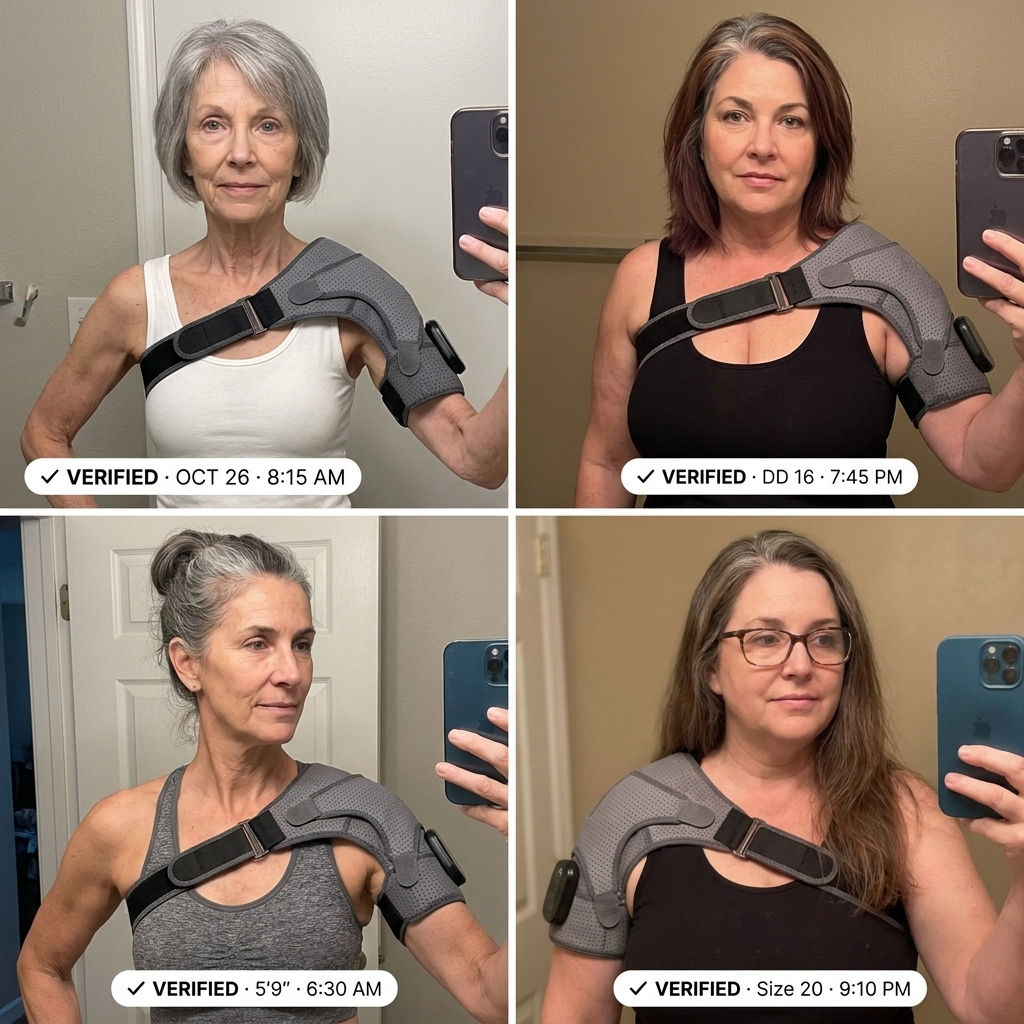
ShoulderEase was cut for the real range of bodies a woman in her 50s or 60s actually has. Wider across the chest panel. Adjustable strap under the arm. Sits above the bust line instead of across it. Three sizes, with a sizing guide that doesn't require a tape measure — just your usual bra size and shirt size.
And one other thing that doesn't get talked about enough.
Burns.
A real review reads: "it burned me bad enough to leave a blister." Older skin, and skin on people with diabetes, can feel heat less than you'd expect. Falling asleep in a cheap heating pad is dangerous.
ShoulderEase has two shut-off timers — 15 minutes and 20 minutes. You pick one. Once it hits, the wrap cools down on its own. You wear it over a cotton nightshirt, never against bare skin. We'd rather build a wrap that errs on the safe side than one that burns you while you sleep.
Here's what "wait it out" actually looks like.
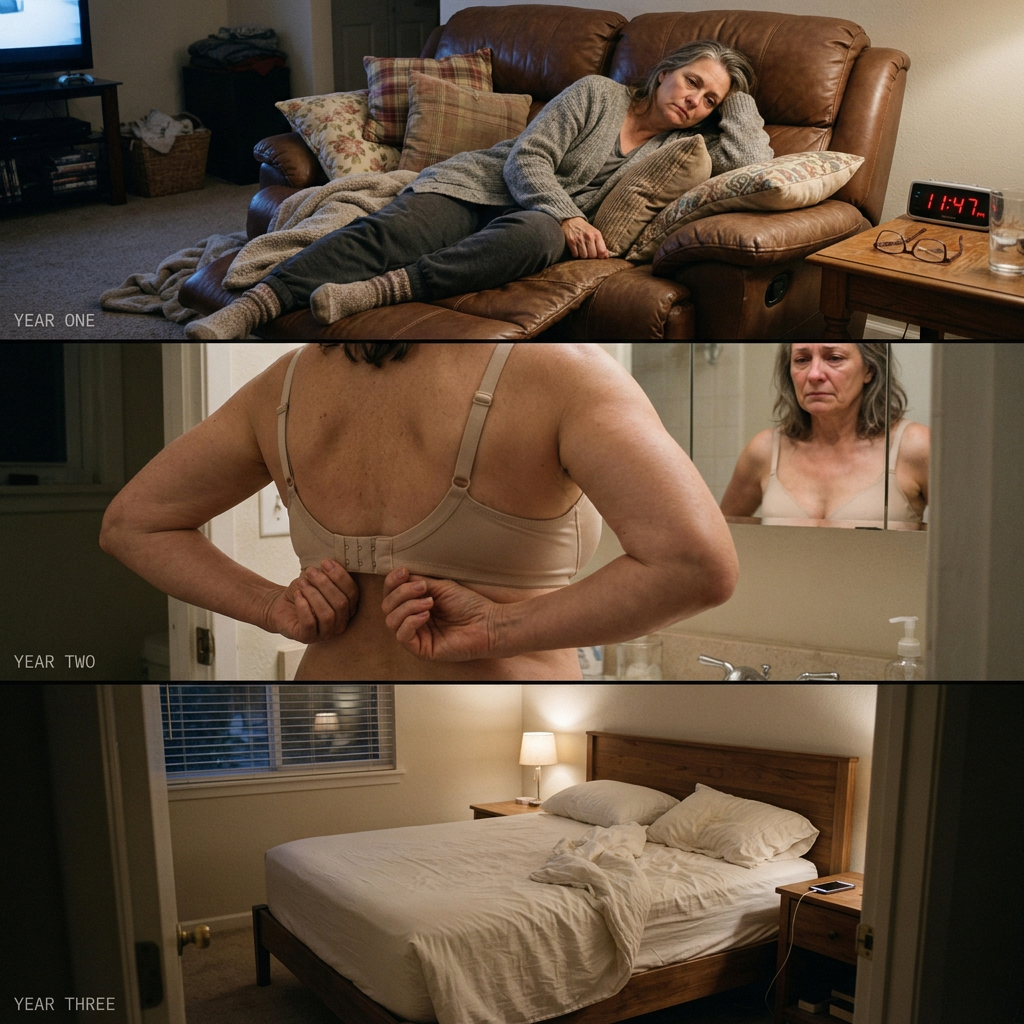
Year one. You move to the recliner. Not because you want to, but because you can't find a way to lie down flat. You're propped up on five pillows. Then seven. Then eight. Your husband is in the bedroom. You are in the living room. Some nights, if you're lucky, you get four hours.
Year two. The pain is still there. You stop doing up your own bra. You stop washing your own hair properly. You stop wearing certain clothes because you can't get them on. You can't close the boot of the car. You can't make the bed. You can't drive on bad days. Your husband does more and more. You feel smaller and smaller.
One woman described it like this: "When you are in pain every day, it makes it harder to cope with everything else in life and you feel like a failure at work and a failure at relationships."
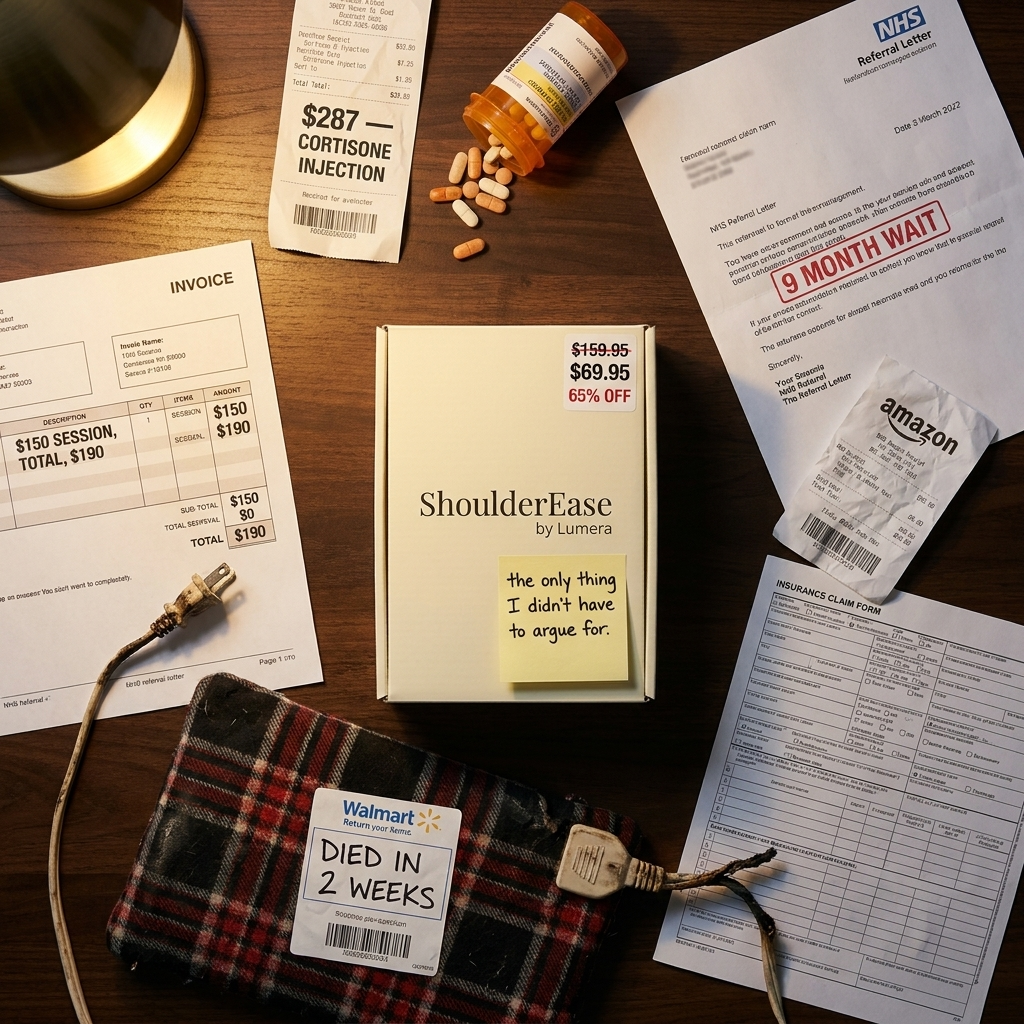
Year three. Your doctor refers you for another cortisone shot. Maybe one for surgery. You're told the waiting list is nine months. You're still sleeping apart from your husband. One woman wrote: "I've not exactly been hugable or even in the mood to be anything but be miserable."
Three years is the number doctors give. One case series found a third of patients still had symptoms after 4.4 years.
Every night you spend in the recliner is a night you don't get back.
But tonight doesn't have to be one of them.
This is the part no one warns you about.
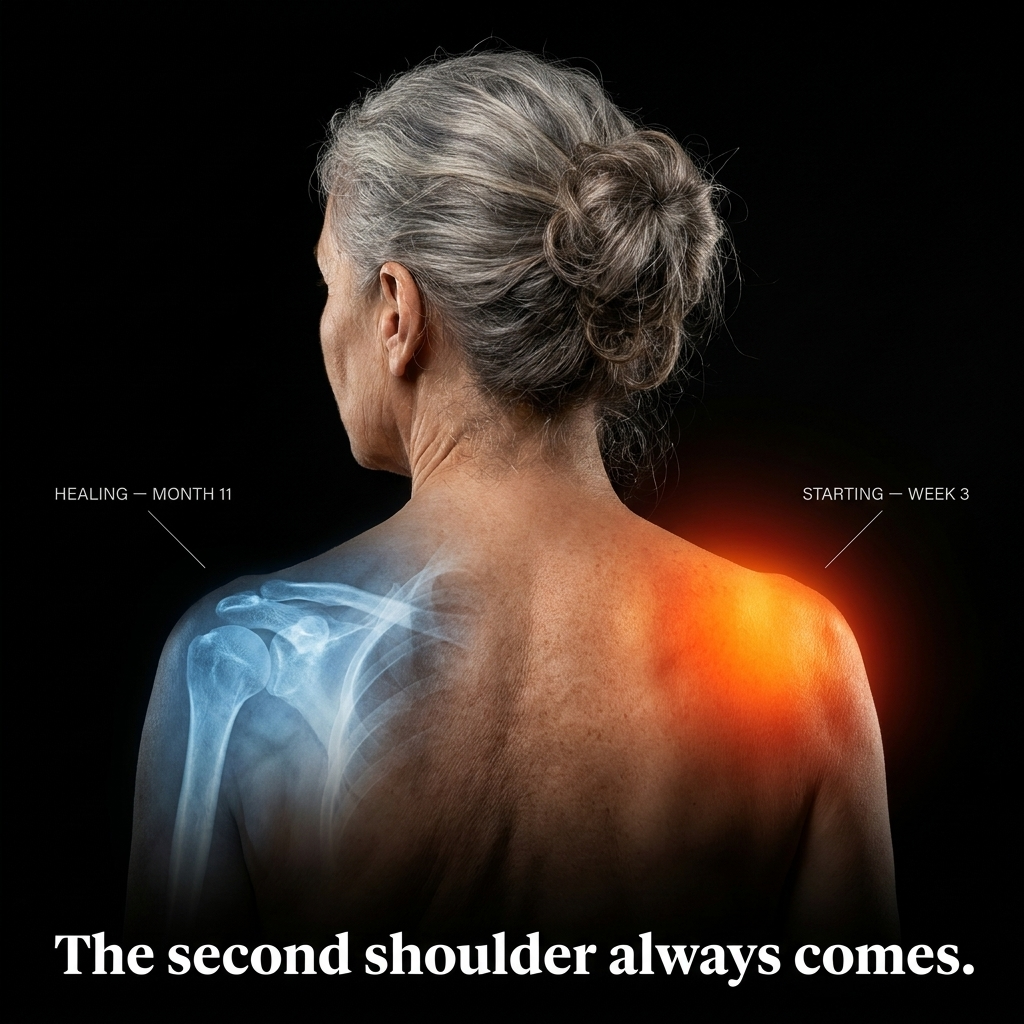
Women who have had frozen shoulder on one side have a documented higher risk of getting it on the other. On the forums, you can almost feel the heart drop in the posts.
The women who have been through it once order a second wrap immediately. One for the shoulder that's hurting now. One in the drawer for the one that might. Some order a second for their mother. Or their sister. Or the friend who hasn't admitted how bad it's gotten.
A real five-star review on Walmart: "I Bought 2 of these because I have shoulder issues and don't want surgery." Another: "Got for my mother and she loves it."
This isn't an upsell trick. It's what the buyers of this category actually do.
If you want one in the drawer for later, or one for someone else who hasn't told you how much they're suffering, we put together a two-pack at a lower per-unit price. Scroll down — you can pick it as your plan.
Half price today. 60 nights to try it. If you're still sleeping in the living room, send it back for a full refund — we pay return shipping.
Try it for 60 nights. If you're still sleeping in the recliner, send it back. We pay return shipping. One email to our support team starts the return. You keep the shipping — we eat it.
The wraps you already tried had "nonrefundable" at checkout. One woman wrote: "I was going to return the item but found out it's nonrefundable. So, I'm out $32." Another, about a wrap that stopped working: "Died within a couple of weeks, and absolutely impossible to return. Literally just threw out $60!"
We know. That's why the guarantee exists.
You won't post about this.
You won't write a five-star review the first week.
What will happen is that one morning, in two or three weeks, you'll make yourself a cup of coffee and you'll realize you've been standing in the kitchen for ten minutes and you haven't once thought about your shoulder.
That's the change.
It isn't a cure. Your shoulder is still healing on its own time, the way frozen shoulders do. But the hours between 10pm and 6am — the hours that have been the worst part of your day for months — will slowly stop being the worst part of your day.
You walk back into your own bedroom at 10. Your husband rolls over. You are there.
Frozen shoulder didn't make you weak. Nobody believing you did.
ShoulderEase doesn't fix frozen shoulder. It just gives you back the one part of the day that was supposed to be yours.
★★★★★ 4.8 average · based on verified customer reviews